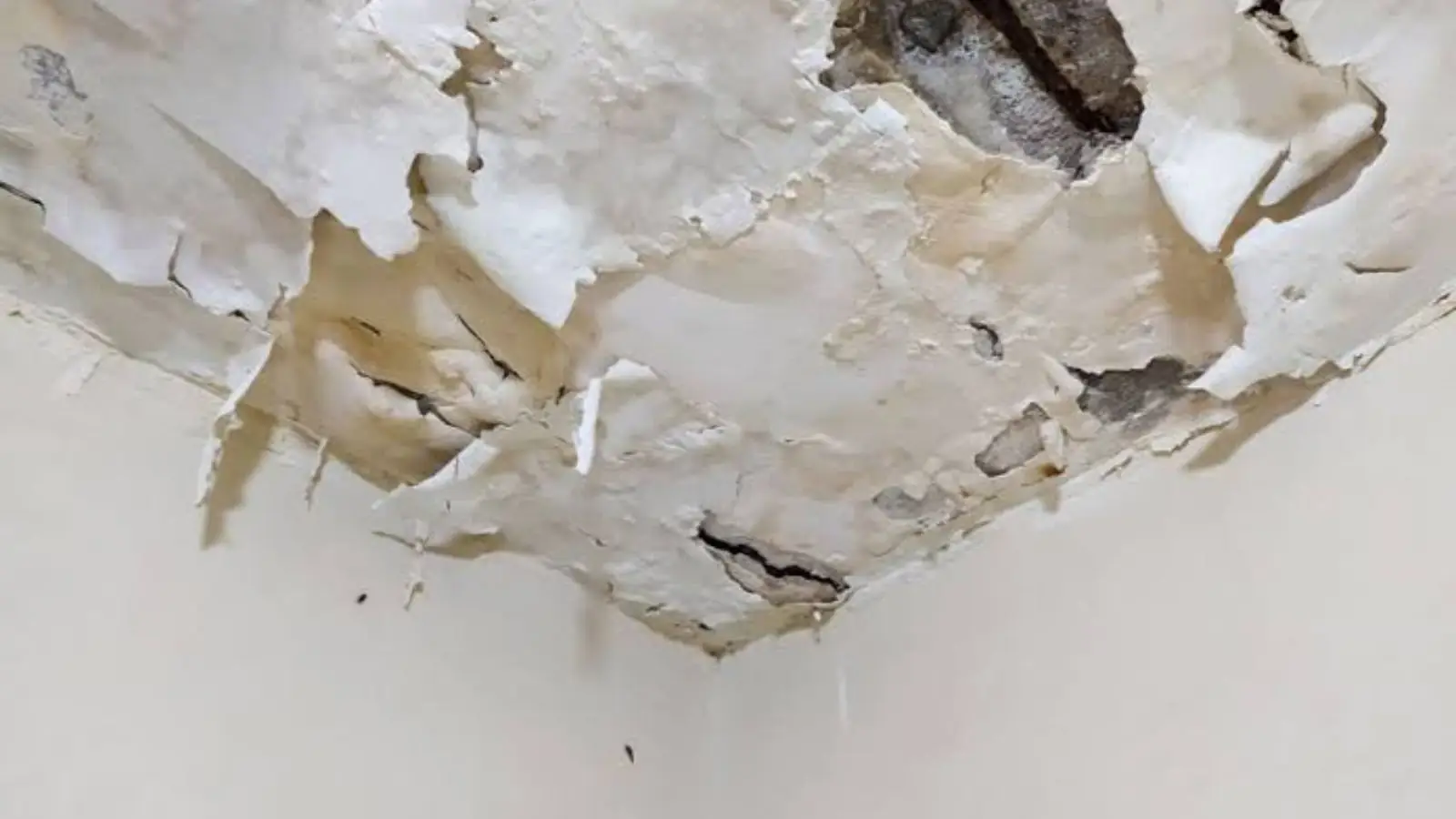
Water damage on a ceiling in Hopkinton, MA is any stain, bubble, sag or soft spot caused by moisture reaching the drywall or plaster from above or from inside the ceiling cavity. The mark you see is only the place where the water finally showed itself. The source can sit several feet away, so reading the pattern correctly saves you from fixing the wrong thing.
What the stain is telling you
Not every ceiling mark means the same thing. Shape, color and edges separate an old, finished leak from one that is still active, and that difference decides whether you have a repair job or a drying emergency.
| What you see | What it often means | First move |
|---|---|---|
| Light tan patch with soft, fuzzy edges | Recent or ongoing seepage that is still spreading | Find the source today and start drying |
| Brown ring with a darker, sharp outer edge | Repeated wet-and-dry cycles, often a slow leak | Trace the source, then check the cavity above |
| Yellow or brown stain, fully dry and hard | An old leak that stopped | Confirm it is dry with a meter before painting |
| Bubbled or blistered paint | Moisture trapped behind the paint film | Do not paint over it, find the water first |
| Sagging or bowed drywall | The board is holding water and has lost strength | Relieve the water safely and keep people out from under it |
| Dark spots or a musty smell | Moisture has lasted long enough for mold to start | Dry fast and read about mold before touching it |
Sagging is the warning sign that matters most
A flat stain is a cosmetic problem. A bulge is a weight problem. Wet drywall can hold a surprising amount of water, and the board will keep sagging until the water finds a way out. If a ceiling is bowing, stay out from under it and move furniture away.
Do not poke a relief hole while standing directly below. Many homeowners put a bucket under the low point, keep their face and body to the side, and make one small opening so the water drains in a controlled way. If water is running near light fixtures, turn off that circuit at the panel first.
The five usual sources
Roof leak
Water enters at a flashing, valley or damaged shingle and travels along rafters before dropping. The stain often sits far from the actual hole.
Ice dam
Melting snow refreezes at the eaves and backs water up under shingles. Stains show up along exterior walls during or right after a thaw.
Bathroom above
A failed wax ring, shower pan, tub seal or drain leaks only when the fixture is used. The stain may come and go.
Supply line
A pinhole in a pipe, fitting or appliance hose leaks constantly, day and night. It is the stain that never fully dries.
Condensation
Warm air hitting a cold duct or poorly vented attic surface drips on the drywall below. Look for dampness on ducts and bath fan runs.
Clues that point to one source or another
Timing is the best detective tool. Ask when the stain grows and match it to something happening in the house.
- Grows only when it rains or snow melts: roof, flashing or ice dam.
- Grows when someone showers or runs the tub upstairs: bathroom fixture, drain or seal.
- Grows steadily whether or not anyone is home: pressurized supply line or appliance hose.
- Appears on a cold morning and fades by afternoon: condensation on a duct or attic surface.
- Located under a laundry room, kitchen or second-floor bath: look at drain lines and appliance connections first.
Why Hopkinton ceilings stain in winter
The National Weather Service's 1991 to 2020 normals for Worcester, the regional climate station, show about 72.9 inches of snow in a normal year. That snow is the fuel for ice dams, which form when heat escaping into the attic melts the snow and the water refreezes at the cold eaves. Worcester is not Hopkinton, so treat the number as a regional guide.
The practical tie-back is simple. If a stain appears along an outside wall during a thaw, look at the roof edge and the attic insulation before you suspect plumbing. A stain that returns every winter in the same place usually points to the roof edge, not a pipe.
Source type: NWS 1991-2020 normals
A quick way to confirm what you are dealing with
- Take dated photos of the stain and trace its edge lightly in pencil so you can see if it grows.
- Check the room above for fixtures, appliances and exterior walls.
- Look in the attic if you can reach it safely, checking insulation, the roof underside and any duct runs for dampness.
- Press gently around the stain with a gloved hand. Soft means the drywall is wet inside.
- Run water in the upstairs fixture for a few minutes while watching the ceiling below, then repeat for the next fixture.
What to do next
Stopping the source always comes first, because no drying plan works while water is still arriving. Once the water is off or the roof is covered, the wet materials need to dry quickly. Water mitigation is the work of finding hidden moisture with meters and drying the ceiling cavity so the damage does not spread.
After the area reads dry, water damage repair covers the cutting, patching, priming and painting. Skipping the drying step and painting straight over a stain is the single most common reason a ceiling stain comes back.
The same stain patterns appear in neighboring towns. If your home is nearer Westborough or Milford, the reading steps above apply there too, and the same dispatch team covers those service areas.
Not sure what the stain means?
Call (508) 446-9244. Describe the stain, the room above it and when it grows, and we will help you decide what to do first.
Frequently Asked Questions
Yes. A dry, hard stain with a sharp brown edge often marks an old leak that stopped. Still confirm with a moisture meter before you paint, because a stain can look old while the board is still damp.
No. Bathrooms above, supply lines, appliance hoses and condensation on ducts all produce brown rings. Matching the timing of the stain to rain, showers or constant flow usually narrows it down.
Not necessarily. The town says iron in its water can cause orange and brown staining. Staining alone does not prove the source, so look at whether the stain grows with rain or with fixture use.
Not before the area is dry and the source is fixed. Use a stain-blocking primer only after a meter shows normal readings, otherwise moisture stays trapped behind the paint.
Right away. A bowed ceiling is holding water and can drop. Keep people out from under it, protect belongings and call for help before the board fails.